The Science
Why These Numbers
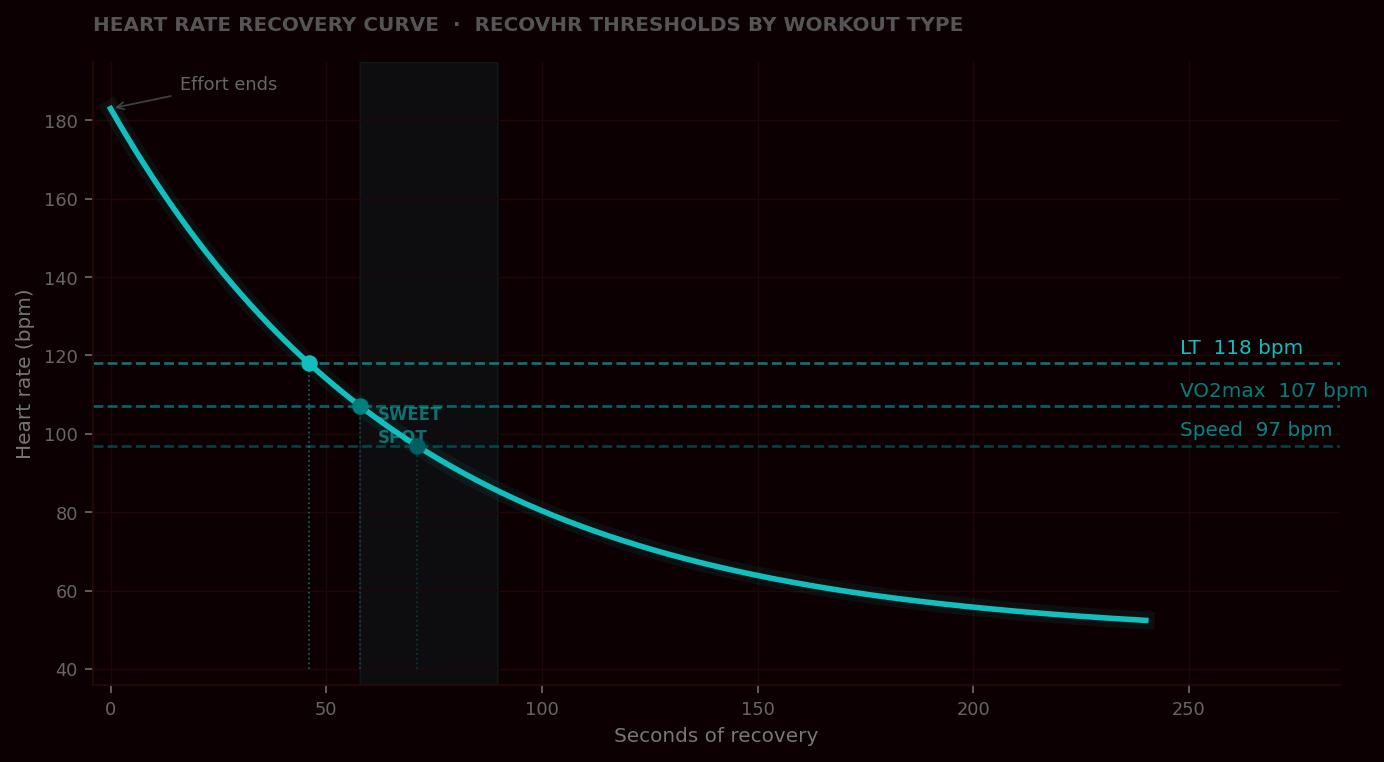
The Recovery Curve
90–140s
Sweet Spot Window
RecovHR targets the exact zone where HR has dropped enough to go hard again — without losing the training stimulus from incomplete rest.
Learn more
After a hard effort, HR decays exponentially. The fast phase (~30s) is parasympathetic reactivation. The slow phase (30s–3 min) is sympathetic withdrawal. The shaded region in the chart marks the window: past the point where cardiovascular stress has dropped, but before complete autonomic reset dilutes the training signal.
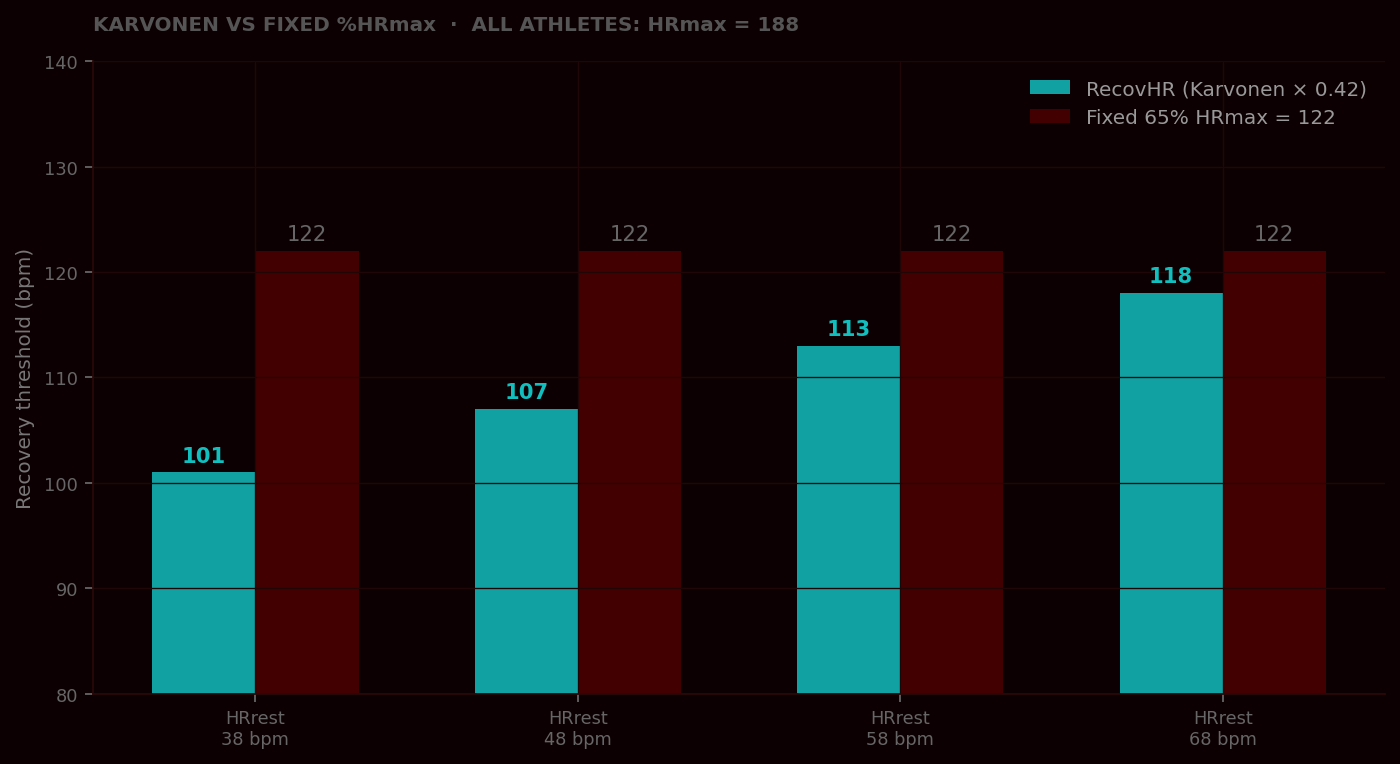
Why Not % HRmax?
21 bpm
Difference at same HRmax
Two athletes, same HRmax — but resting HR differs by 30 bpm. Karvonen corrects for that. A fixed %HRmax ignores it entirely.
Learn more
At HRmax 188 with HRrests of 38 vs. 68, the "65% HRmax" recovery target is identical for both athletes (122 bpm). But the Karvonen formula gives 101 bpm vs. 122 bpm — a 21-bpm spread that reflects their very different physiological readiness states.
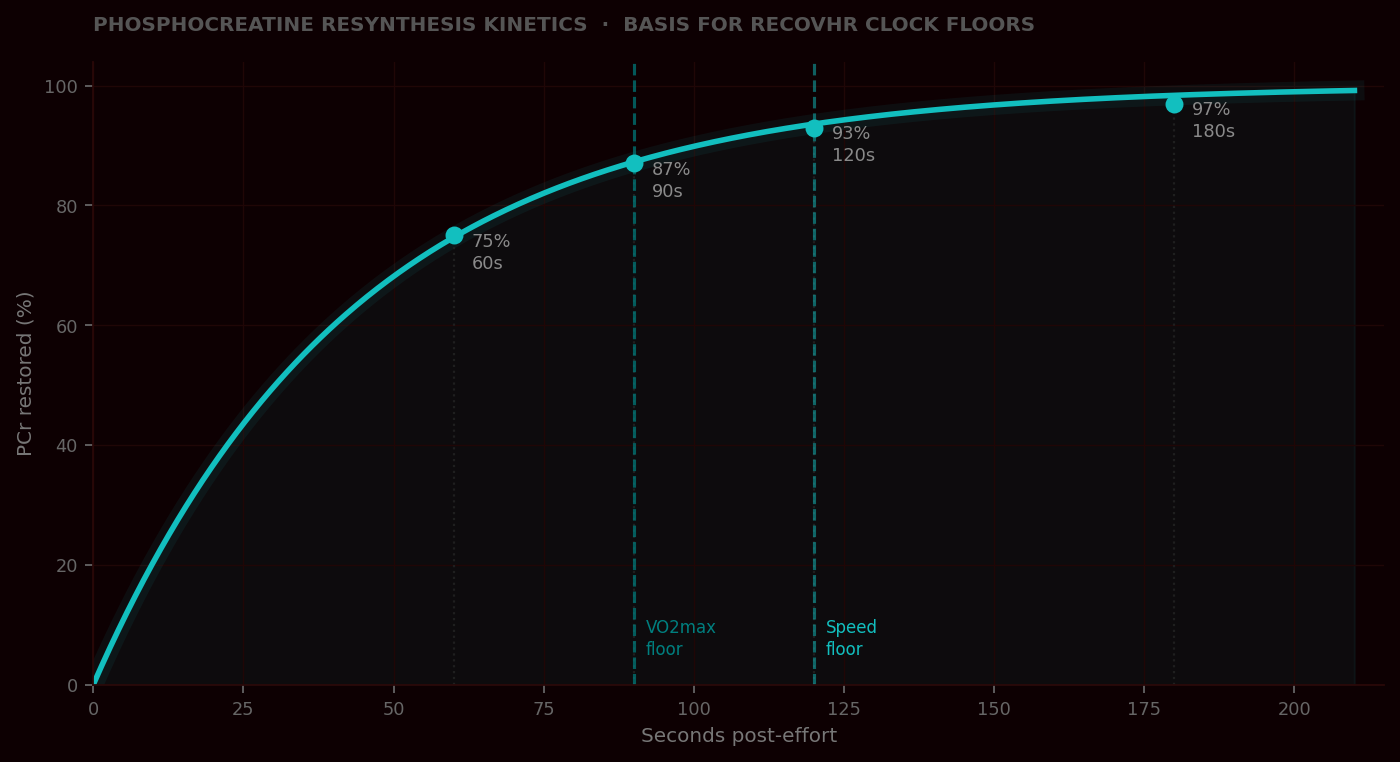
The Clock Floors
90s = 87%
PCr Restored
No matter how fast HR drops, the fuel must be physically ready. Clock floors enforce the PCr resynthesis timeline.
Learn more
Phosphocreatine (PCr) is the immediate fuel for maximal efforts. It has a half-life of ~30s (Harris et al., 1976). At 90s, 87% is restored; at 120s, 93%. The VO2max floor (90s) and speed floor (120s) are pinned to these resynthesis milestones — preventing any rep from starting before the fuel system is ready.
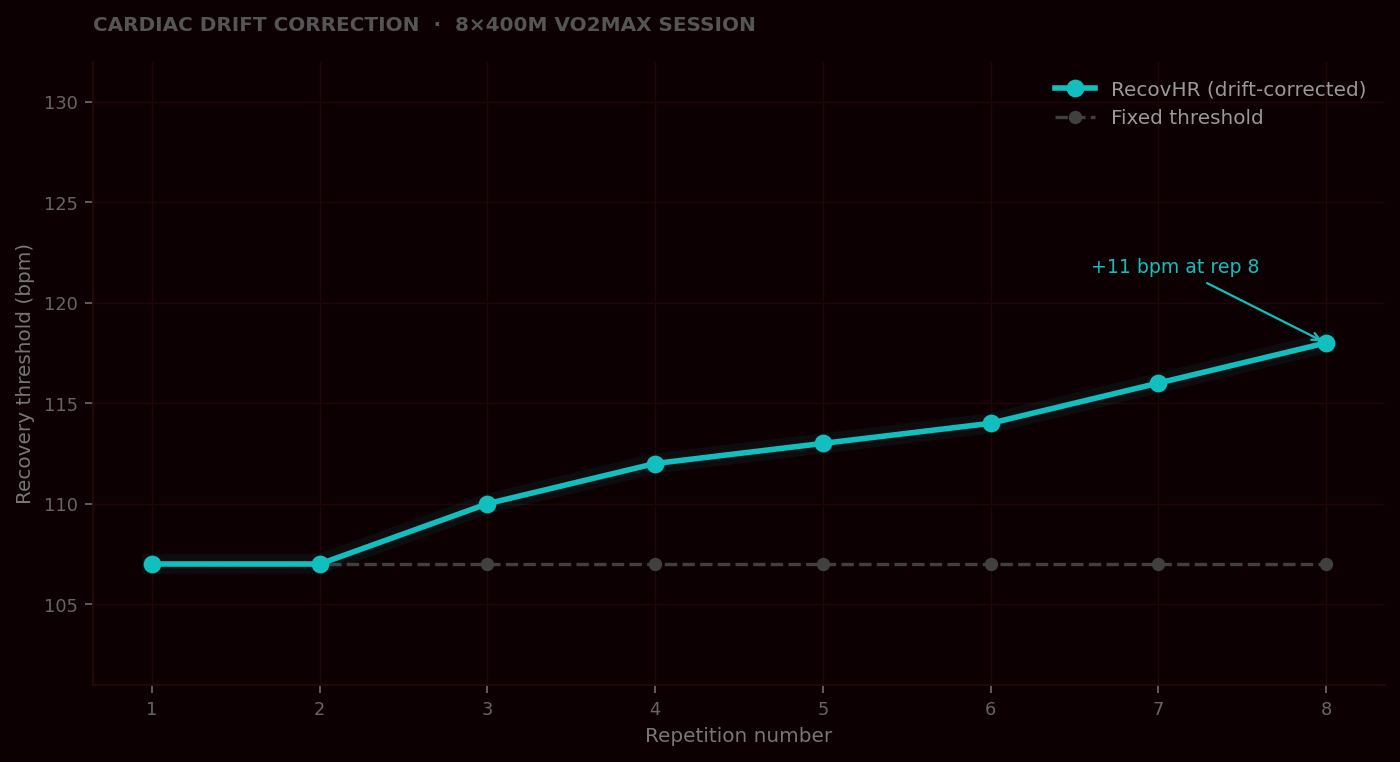
Cardiac Drift
+1.5 bpm
Per Rep from Rep 3
A fixed threshold gets harder to meet as the session progresses. RecovHR adjusts each rep to match actual cardiac drift.
Learn more
In a multi-rep session, end-of-recovery HR rises 1–2 bpm per rep due to thermoregulation and dehydration (Rampinini et al., 2015). Without correction, rep 8 with a fixed threshold demands 45–75 extra seconds — systematically diluting late-session training stimulus. RecovHR adds 1.5 bpm/rep from rep 3 onward to preserve identical readiness across the full session.